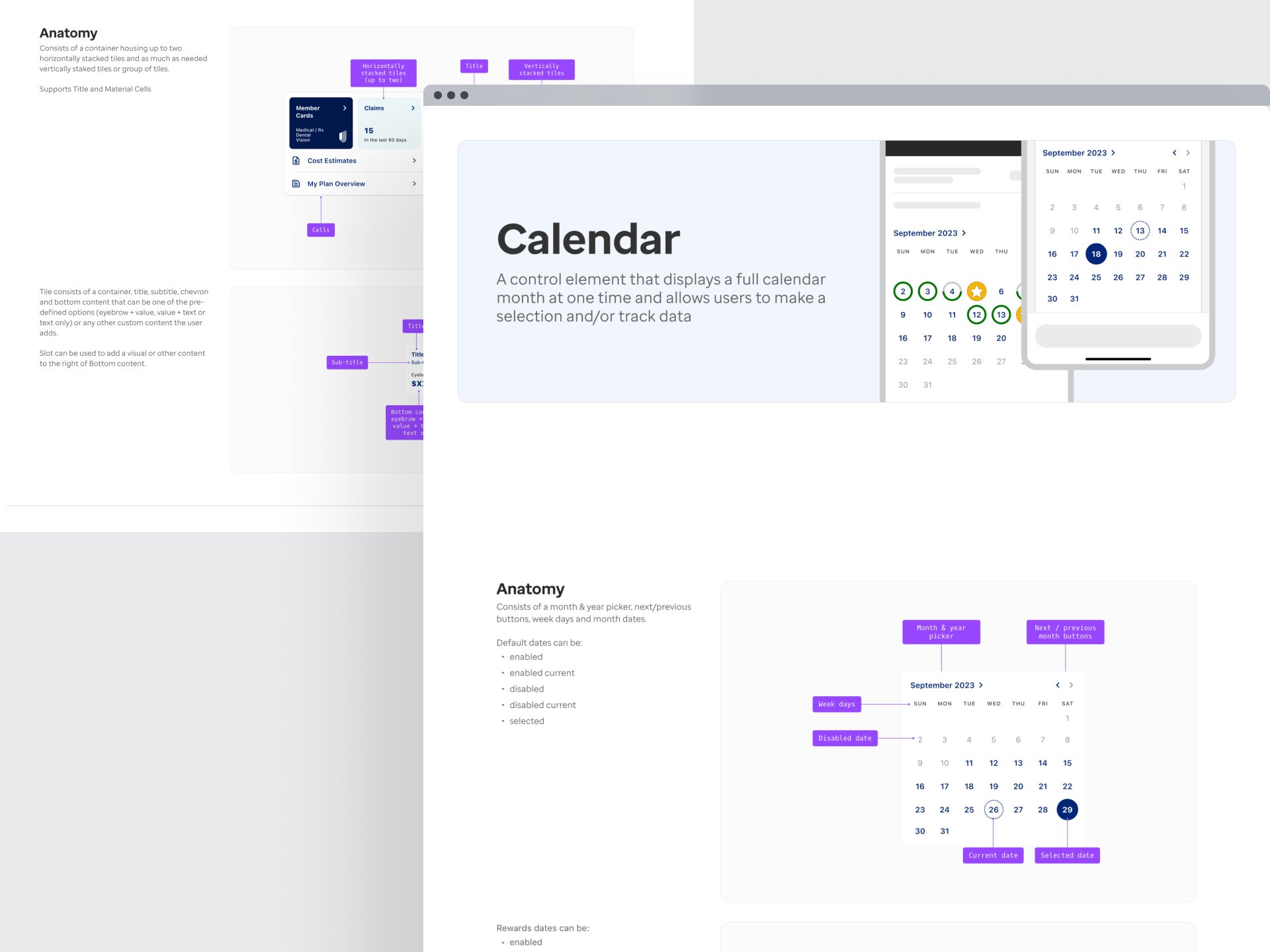
Healthcare provider
Designing foundations & tokens architecture to enable scalable product experiences
Role: Lead Product Designer ∙ Tokens Architect
Client: top 3 “Fortune 50” US healthcare provider
Timeline: 2024 - 2026
Context
A top 3 “Fortune 50” US healthcare provider with multiple digital products faced growing UX inconsistency and product team friction. While a Design System existed, it had evolved in a reactive, product-specific way, leading to:
Uneven experiences across products and brands
Increased rework and decision overhead for teams
Slower delivery due to ambiguous patterns and governance
As white-label initiatives expanded, scaling consistent, high-quality experiences became a strategic challenge.
Opportunity
The Design System needed to evolve from a passive asset into an active product enabler that reduced friction, improved decision clarity, increased delivery speed and helped teams deliver cohesive experiences with confidence.
I led this evolution with a product mindset, focusing on:
Improving UX quality and consistency.
Enabling teams to make faster and more confident decisions.
Supporting scalable delivery across multiple brands and platforms.
Future-proofing the architecture to serve as a runway for enterprise AI enablement, ensuring emerging predictive and GenAI tools can be deployed seamlessly.
My role was to align shared foundations with product goals, making them an asset for teams, not a bottleneck.
Approach
I focused on the Design System as a product experience, aiming to solve cross-team friction, lack of strategy and clarity, and inconsistent foundations, grounded in research and cross-team collaboration.
-
I collaborated with product designers and engineers to identify where inconsistent behavior and unclear theming slowed feature work or created UX debt.
This clarified what needed standardization versus where product flexibility was valuable.
-
Decisions were framed around 3 strategic balances:
Consistency vs. Flexibility
Define key foundation values and UX behaviors while allowing controlled visual variation to express brand intent.Speed vs. Scalability
Prioritize work that unblocked teams immediately while preserving long-term flexibility.Clarity vs. Complexity
Reduce cognitive load with well-defined values, processes and documentation.
Using AI-assisted exploration, I analyzed best practices, tokens architecture and taxonomy, tested naming conventions, and considered edge cases early, to support faster, more confident design decisions.
-
Defined a 3-tier token architecture (core → semantic → component) that translated product intent into reusable, scalable building blocks and supported multi-brand theming.
This gave us:
Clear foundational definitions (spacing, typography, color, sizing, border width, border radius, elevation).
A white-label-ready framework to support cross-brand consistency.
Adaptable components for diverse workflows.
-
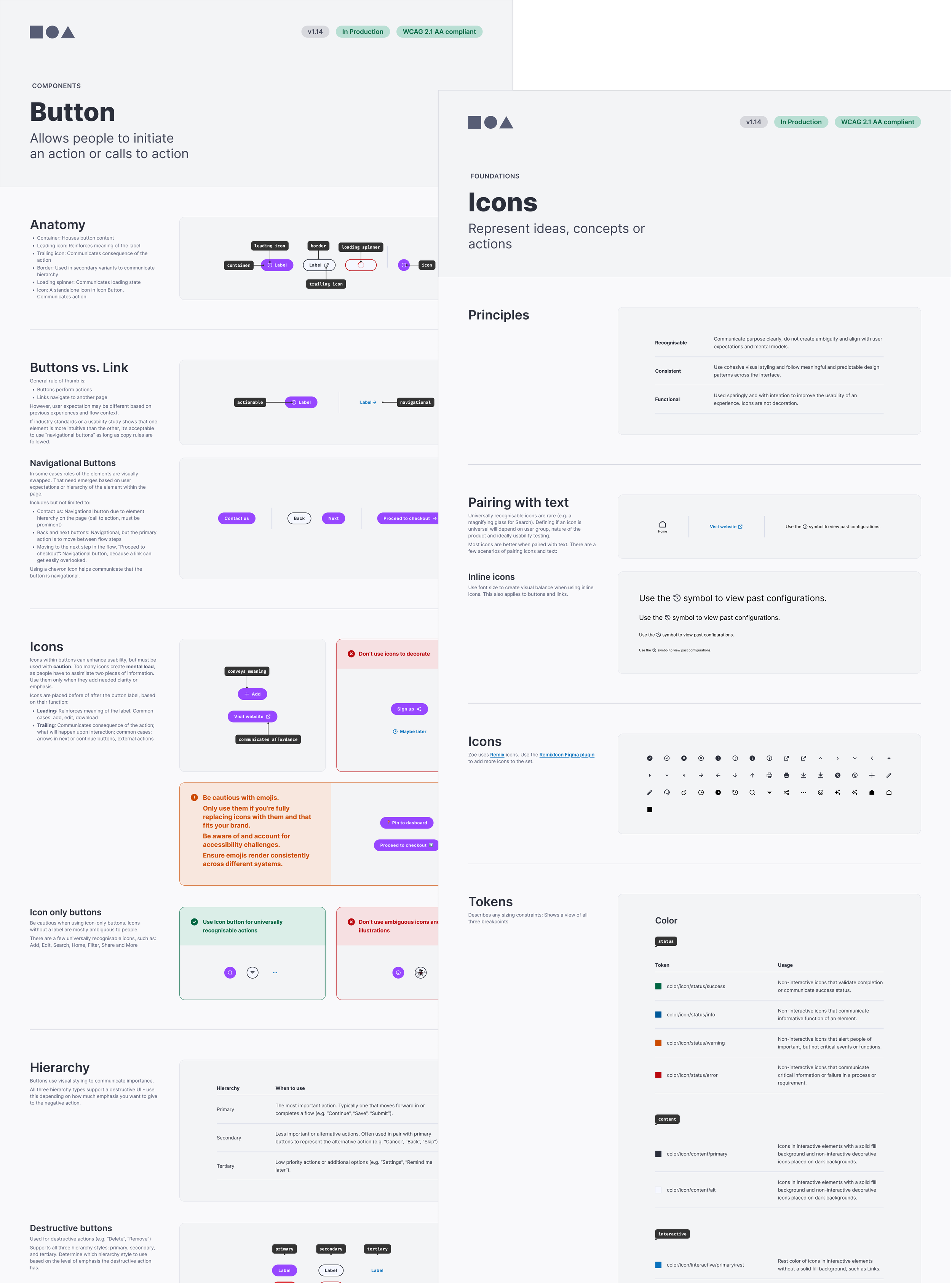
I designed contribution and review workflows supported by documentation (usage guidelines, decision logs, dev handoff) and workshops, enabling teams to know when to use standard foundations and when to safely customize them, increasing autonomy and confidence.
-
A major hidden cost of AI integration is UI fragmentation. By establishing a strict, code-mirrored token taxonomy and clear governance for complex data visualization, I ensured the system could act as a launchpad for future AI features.
When engineering needs to deploy a new generative AI chat or predictive risk dashboard, the semantic foundations are already in place to surface complex data without overwhelming the user.
Key decisions
These strategic calls unlocked faster, more consistent product delivery:
Standardize behavior over expression
Prioritized consistent UX behavior and accessibility, while allowing visual variation to support brand and product differentiation.
Confidence over control
Designed foundations and workflows that empowered teams to make the right decisions independently, rather than relying on centralized approval.
Reduce complexity to increase speed
Fewer, well-defined foundations reduced cognitive load, improved consistency, and sped up design and development cycles.
What this meant for the company
Outcome
Consistent, higher-quality user experiences across multiple products and brands.
Reduced rework and ambiguity for designers and developers.
Increased confidence in UX and theming decisions.
Faster onboarding for new designers and engineers.
Strong adoption and trust in shared foundations as core assets.
Impact
7% reduction in design/development time due to clearer foundations.
Many teams improved compliance & adoption within one month of framework rollout.
Faster multi-brand enablement via the white-label architecture.
Reduced operational risk with clearer guidance and fewer ad-hoc solutions.
Established a robust, scalable UI infrastructure capable of accelerating the time-to-market for future AI-driven products across the enterprise.
These results strengthened trust in shared foundations as a strategic enabler of scalable product experiences, not just a library.
Learnings
This project reshaped not only the Design System, but how teams collaborated, and scaled together:
Design Systems succeed or fail based on communication and governance, not components alone.
Clear token semantics dramatically reduce cognitive load and decision fatigue.
Enablement and education are critical to adoption at scale.
AI is a powerful partner for systems exploration, but human judgment remains essential.
This work reinforced how solving complex product challenges at scale requires intentional tradeoffs between UX quality, delivery speed, and flexibility.
Close partnership with product, design, and engineering teams taught me how to create shared direction while enabling autonomy.